TEXT
Wesley Arden Dick, Professor of History, Albion College
“What could a slaveowner do to his slave? He could whip his slave, beat his slave, rape his slave, or murder his slave. There was one thing he could not do: he could not educate his slave.”—Tell Them We Are Rising
Background
Albion, Michigan, a small town, was founded in the 1830s. Its location at the confluence of the north and south forks of the Kalamazoo River attracted early settlers because the water flow at the site could power grist and lumber mills. Mills were a defining economic presence for Albion during its pioneer phase. After the Civil War, heavy industry was initiated and by 1900, Albion had become an industrial city. The Albion Malleable Iron Company was considered the “mother factory,” and it attracted and recruited immigrant workers who entered America through Ellis Island. When the Great War broke out in Europe in 1914, immigration from Europe was curtailed. In need of workers, the Albion Malleable Iron Company went south to Pensacola, Florida. The company recruited 64 men who traveled by train to Albion in November of 1916. Their families soon joined them. Albion had become a host of the fabled Great Migration of African Americans from the South to the North. In subsequent years, more African Americans made the journey from the South to Albion.
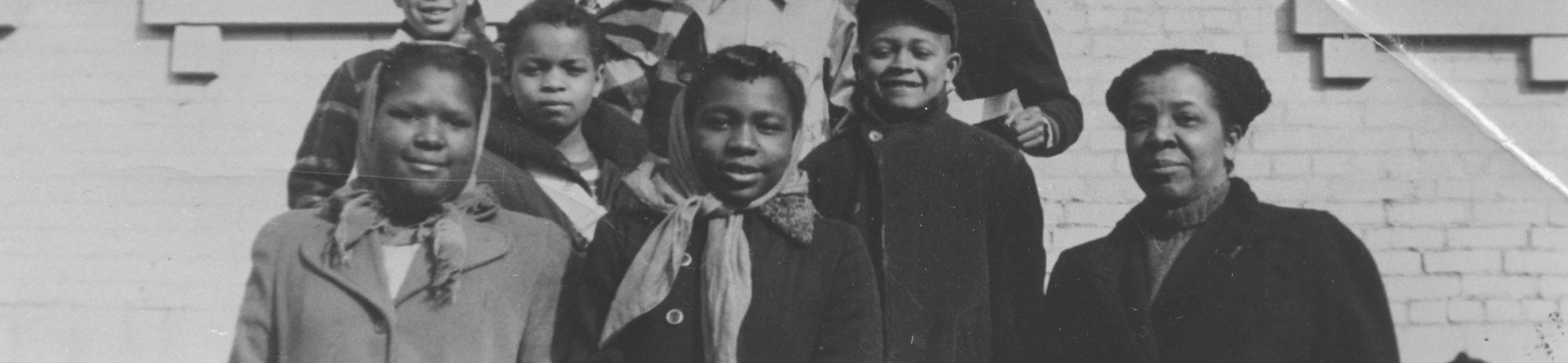
The African Americans who came to work for the Albion Malleable Iron Company during World War I found housing near the factory on the west side of town. When their children followed, the city faced a dilemma. Where would the Black children go to school? The West Ward Elementary School was the closest neighborhood school. Since 1873, West Ward had been the school for immigrant children whose fathers worked at The Malleable or the nearby Gale Manufacturing Company. At first, the newly arrived African American students were educated in black church facilities. In January 1918, Dalrymple, a new elementary school, was dedicated. Dalrymple School was in the same general neighborhood as West Ward. An agreement was reached to send the white children, who had been attending West Ward, to Dalrymple and convert West Ward into an all-Black elementary school. Albion’s growing Black community supported this arrangement. Why did they do that? The only way there would be Black teachers was under this arrangement. These families and their children had lived in the South where the segregated Black schools had Black teachers. Thus, this bargain for a segregated elementary school in Albion was implemented in 1918.
This afternoon, I want to highlight three of the teachers at West Ward: Lena Stevens Cable Holmes, Ruth Ferguson, and Mildred Biggs. LENA STEVENS was born in Blondike, Illinois, on August 27, 1888, graduated from high school in Alexander County, Illinois, and taught in Birds Mill, Missouri. She married Robert Cable, also from Illinois, and the two graduated from Hillsdale College in 1917. The two were hired by the Albion Board of Education in 1917: Robert as principal and Lena as a teacher at West Ward. When Robert became ill, Lena became Albion’s first Black principal. Following Robert’s death, Lena married William Holmes. In a February 1983 article in the Albion Recorder, 94-year old Lena reflected on her life and especially on her time at the West Ward School. Jean Taylor interviewed Lena and wrote: “Mrs. Holmes is proud of her students who went on to become doctors and lawyers and teachers. … Mrs. Holmes says she tried to incorporate as much black history in her teaching as possible. ‘It’s worthwhile for a child to know what we’ve come through. … I used to draw a tree, and say, here you are (at the bottom). If you work hard and live right, you can get to the top.’” Following retirement as a teacher and principal, she moved to Detroit but returned to Albion, living at Peabody Place. Later she lived with her god-daughter Mrs. Arthur Harris at 823 North Clinton Street. Lena was active in the Women’s Division of the Knights of Pythias and in Bethel Baptist Church. She died on November 28, 1983 at the age of 95. The funeral was held at Bethel Baptist with Rev. Fred Alexander officiating. She is buried at Riverside Cemetery. She was quoted in her obituary: “I’m happy looking back at what I accomplished. All of it has not been good, but enough was accomplished to know I did not work in vain.”
RUTH FERGUSON was born Ruth Morris in Saline, Michigan on November 12, 1900. Her motivation to become a teacher was tied to the history of her parents. Her father, Henry Elijah Morris, was born a slave on a North Carolina plantation. His parents died from smallpox during the Civil War. An orphan, young Henry was taken in by legendary abolitionist Laura Haviland of Adrian, who gathered in “Negro” children following the chaos of the Civil War and raised them in her home for children in Adrian. Ruth’s mother, Nancy Ann Martin, was born in Canada to escaped slaves. Settling in Saline, Henry made a living as a carpenter: Ruth recalled that when the family drove in the countryside, her father would point out the barns that he helped raise. The Morris family was reasonably well off because “they had a garden and a cow.” Ruth hoped to attend college to become a teacher so that she could fulfill her slave ancestors’ admonition to “Help our people.” The family did not have the resources to send her to college. However, a loan from a local banker’s wife rescued Ruth’s college dream and Ruth graduated from Ypsilanti State Normal School, now Eastern Michigan University. Her first teaching job was at an all-Black school in Paducah, Kentucky. She was hired to teach at the West Ward School in 1926. In 1937, Ruth Morris married Clifton Ferguson, who worked at The Malleable Iron Company and at the Gale Foundry. In 1951, Ruth Ferguson received a master’s degree from the University of Michigan. In reflecting on her lifetime of teaching elementary students, she told a reporter: “…What might be a small thing to the white race but of extreme importance to small Negro children: Seeing a Negro child in a textbook helps. … Oh how happy it makes a Negro child to see a small colored boy or girl in a textbook.” She was proud of the hundreds of children who filled her classrooms. She lived at 114 South Albion Street, and the Ferguson home was an after-school sanctuary for the West Ward neighborhood kids. Ruth taught Sunday school at Leggett Chapel AME Zion Church. She was active in the Albion Branch NAACP and Albion civic affairs and organizations. Ruth Ferguson died on January 17, 1971. She is buried in Riverside Cemetery.
MILDRED BIGGS was born in Albion in 1921. Her father, Garfield Biggs, was one of the 64 men who arrived on that train from Pensacola, Florida, in 1916, hired to work at The Albion Malleable Iron Company. Mildred grew up in the West Ward neighborhood and attended the West Ward School. She graduated from Washington Gardner High School in 1938 and went south to college at a historically Black College, Talladega College in Alabama. Later Mildred would earn a master’s degree from the University of Michigan and also do post-graduate study at Michigan State University and Western Michigan University. She began teaching at the West Ward School in 1942. Mildred was active in the Albion Branch NAACP and in several churches. She received many honors, including The Sojourner Truth Meritorious Service Award. In 1981, the city of Albion proclaimed “Mildred Biggs Day”—“Her contributions are of lasting value, and will continue to remind us of her commitment, awareness of people, and concern for the care and development of our children.” Mildred Biggs died in Chattanooga, Tennessee on March 24, 2014.
Lena Cable Holmes, Ruth Ferguson, and Mildred Biggs represent the full chronological history of Albion’s segregated, all-Black West Ward School. The three, of course, knew each other and worked together. In recalling her former students, Lena Holmes was particularly proud of those who had become teachers themselves, noting that Mildred Biggs had been her student. Through their dedication and care, generations of Albion elementary school children were given a leg up on the American Dream.
As the post-World War II civil rights era emerged, African American parents began to question the existence of an all-Black, segregated school in Albion. In 1953, Black parents in tandem with the NAACP, boycotted West Ward, forcing the Albion Board of Education to close the school that October. Segregation was considered a solution rather than a problem in 1918; by 1953, segregation was indeed perceived a problem, which was confronted through Civil Rights resistance. It is interesting to note that the decision to close the West Ward School occurred seven months before the fabled Brown vs. the Board of Education, Topeka, Kansas Supreme Court decision, which outlawed segregation in public schools.
[This chapter of Albion’s history has been highlighted through historical displays in Holland Park, the location of the West Ward Elementary School which was demolished in 1958, and through an oral history project that included 20 interviews of former West Ward students. The interviews are available to the public at www.albionwestward.com.]
Following West Ward’s closure, most West Ward students transferred to Dalrymple Elementary School. Lena Holmes retired. Ruth Ferguson and Mildred Biggs would become teachers at Crowell Elementary School. Mildred Biggs became the first African American principal of an integrated Albion School when she was appointed principal at Dalrymple in 1969. However, hiring additional African American teachers for Albion Public Schools was not a priority. The West Ward School story reminds us that Black Teachers Matter.
FAST FORWARD to the late 1960s. By this time, Albion’s African Americans made up approximately 25% of the city’s population of 12,000. There were very few African American teachers in the Albion Public School system. Racial tensions erupted at Albion High School. The absence of Black teachers was an issue. Albion School administrators came up with a plan. Albion would look to the South to the Historically Black Colleges and Universities (HBCUs). Recruiting trips were made and a cohort of Black teachers was recruited to Albion from Louisiana, Arkansas, Mississippi, and Georgia, from Grambling University, Southern University, Fort Valley State College, Jackson State, and Arkansas A & M. Beginning in the early 1970a, Mae Ola Dunklin, Eddie Williams, Barbara Landry-Davis, Hazel Lias, and Vivian Davis were among the African American teachers that were recruited to Albion from the South. In that same era, the Albion Public Schools also hired some Albion natives, grandsons and granddaughters of the first wave of the Great Migration. From 1970 until 2000, Albion Public Schools’ teaching staff included a significant number of Black teachers.
In the 21st Century, that generation of African American Albion Public School teachers retired. They were not replaced by Black teachers. Albion’s teaching staff again resembled the pre-1918 all-white faculty. Meanwhile, Albion’s school system was facing a variety of challenges. Albion, a model of industrialization for more than a century, became a model of deindustrialization as one after another of Albion’s factories closed their doors. For decades, Albion has been confronted with the shock of lost employment opportunities. This has meant decreased tax revenues for schools, a loss of population, and an intensification of poverty among the remaining citizenry. Added to this, Michigan adopted Schools of Choice options. Albion began to lose children to the schools of neighboring communities. No doubt, a variety of motives influenced those who chose to leave the Albion Public Schools, but a pattern of white flight meant that the Albion Schools were becoming more and more Black, more and more meeting the definition of a segregated school system. As the Albion Public School enrollment declined and the school debt increased, the decision was made to close Albion’s high school. An agreement to collaborate with Marshall High School was reached in 2013. Henceforth, Albion High School students were welcomed at Marshall. Soon after, Albion’s Middle School students were transferred to Marshall and, in 2016, Albion voters agreed to have the Marshall School District annex the Albion School District. Albion High School and Middle School students were bused to Marshall. Harrington Elementary School remains in Albion, administered by Marshall Public Schools.
Albion’s community remains diverse. The 2010 census lists Albion’s African American population at 32%. For more than a century, Marshall, Michigan has been known as an almost lily-white town. For the past century, the central stories of Albion and Marshall could be characterized as the “tale of two cities.” Marshall’s annexation of Albion’s schools is, thus, not without irony. Albion’s Harrington Elementary School remains heavily African American and meets most definitions of a segregated school. Although the current principal at Harrington Elementary School is African American, the teaching staff is almost all white. And Albion’s African American students attending Marshall Middle School and High School do not find Black teachers. Thus, in 2020, Albion and Marshall face the challenge that their teaching faculty does not represent their student body. Black Teachers Mattered in 1918, Black Teachers Mattered in 1970, and Black Teachers Matter in 2020. The diminution of the number of Black teachers is a national problem and the decreasing number of Black teachers are in demand. This circumstance makes it easier for school administrators to acknowledge the need for diversity among the faculty, and, in the same breath, announce that Black teachers are very hard to find.
Currently, I am directing, in collaboration with Robert Wall, Leslie Dick, and Akaiia Ridley, Albion College student, an oral history project designed to preserve and tell the stories of Hazel Lias, Mae Ola Dunklin, Barbara Landry-Davis, Vivian Davis, and Eddie Williams. An additional goal is to remind the Marshall School District that Black Teachers Matter and to demonstrate the steps taken by Albion 50 years ago to assure that there were African American teachers, creating a faculty that looked more like its students. Could Marshall take similar steps in 2020? Marshall can learn from this history, contributing to a conversation on the need for Black teachers today.
To conclude, “Albion’s Story is America’s Story.” Albion’s history is tied to the rich history of the Great Migration of African Americans from the South to the North. A modern Great Migration wave brought African American teachers to Albion from the Historically Black Universities and College in the 1970s. Those teachers taught in Albion for 40 years and more before retiring. In retirement, they have remained dedicated to their profession and to the children of Albion. Theirs is a remarkable story, one worth preserving and sharing.
Education has been a Civil Rights issue throughout American history. Education remains a civil rights issue today. For Black History Month and Women’s History Month, this presentation has identified Lena Holmes, Ruth Ferguson, Mildred Biggs, Hazel Lias, Barbara Davis, Mae Ola Dunklin, Vivian Davis, and Eddie Williams as worthy warriors for civil rights in public school education. Albion is in their debt. I honor them.
Thank you.
[Acknowledgment: This presentation at the Albion College presidential home at 501 East Michigan Avenue to Albion’s ELT Club for Black History Month on February 5, 2020 is part of an oral history in the liberal arts project entitled “Albion, Michigan Public Schools: Black Teachers Matter—a History.” “Support for this project was provided by the Great Lakes Colleges Association through its Expanding Collaboration Initiative, made possible by a grant from the Andrew W. Mellon Foundation.”